My Bad vs Your Good
Idea
We all desire for our lives to get “better”. But what does better mean? To each we may have our own definition of better. We might covet something in someone else’s life that they may feel is “bad” or not going well. Human nature desires optimization and resists (sometimes at all cost) regression. It is to protect what we have currently procured and to seek further optimization and procurement.
Without trying to reduce this instinct in us humans to a barberic concept, this desire is truly about survival. A time when food and sustenance was not always at arms reach. When anything lurking nearby was a potential threat to safety and security.
Hypothesis
Our wiring to protect and defend still exist today, yet while we live in vast abundance and resources in the western world. Because this protective instinct is still hardwired into our biology, it no longer watches out for lions, tigers and bears … (you know you said it). Today it’s a social media post. Traffick. It’s an email from your boss or colleague. Or our cheeseburger and fries taking too long at the drive through because someone else infront of us has an overcomplicated order.
So what causes this rage and frustration. Most of us don’t act out on such anger but there are plenty of TikTok and Instagram reels showing us that this instinct gets the best of us sometimes.
We may scoff, and rightly so empathize with the receiver of such uncalled for outburst.
But at the end of the day, this instinct is triggered by our perceived left and right lateral limits. Knowing your lateral limits is a military term for troops. It is a designated area of responsibility for a specific position in battle. This keeps you from focusing on a target that someone else who is better positioned might have their sights on. I use this analogy to describe what might be helpful in us understanding why we all react so differently to different things at different times. Generally speaking each person has what they would describe as “bad” and “good”. For our purposes “bad” is our left lateral limit and “good” is our right. So when we experience something that gets closer to our left lateral limit, or even goes beyond that, that is when we see this instinct really kick in.
Observation
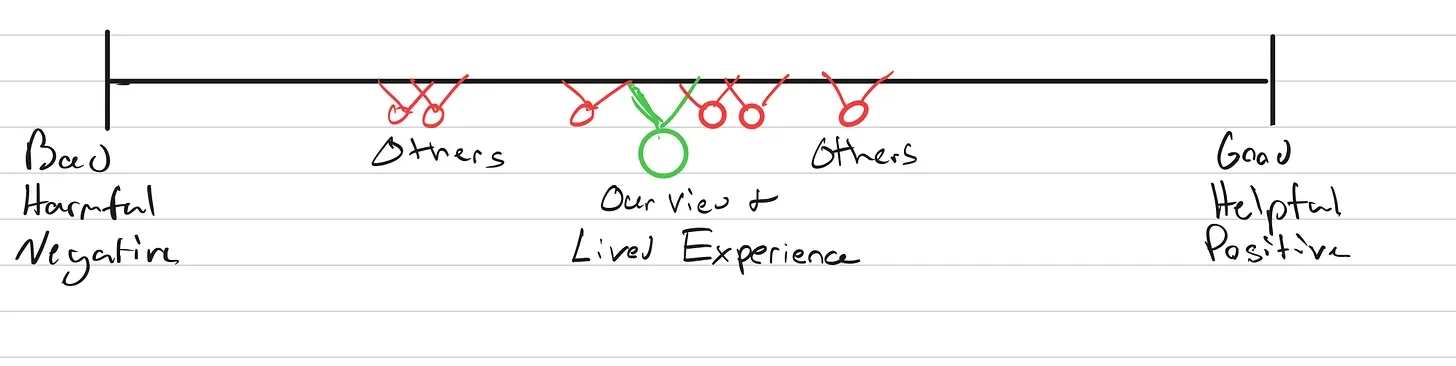
I drew a diagram (though it may look like my childs doing) to help me explain this idea even further. Imagine if all of life’s experiences where on a straight line starting with the worst experience on the left to the best experience on the right. Every human being is positioned to look at that line. Depending on where we are in life and our own personal experiences determines how far left or right we fall on this line.
From our position, to our left lateral limit is our tolerance for bad. Cross that limit, a milkshake gets thrown through the drive through window. A compensatory habit might be formed, and our position on the line “regresses” to the left and new limits are established. On our right, could be a goal or what we perceive as something to be acquired. Once we get it, our position shifts to the right and new limits are formed. I would argue that the closer we are to our individual limit, the closer we are to loosing our composure and maken some poor choices in the moment.
Result
Now imagine populating this same line with everyone around you. How much overlap would there be in the left and right lateral limits. Eached based of the persons lived experience. What some is striving for is the very thing that might set you off if you encounter it at the wrong time. Thus conflict arises. Things are said. Love for humanity no longer exist and threats and enemies are all that we see.
To clarify, this is not a “my truth, your truth” statement. Truth is truth and that can be a topic for another day. However, it is to highlight that the world dose not revolve around us. The person next to you dose not know where you are on this line of life and how close you are to your left or right lateral limit.
I write all this to implor a greater sense of empathy for one another, as well as a greater appreciation for the life that we have.
“Rejoice with those who rejoice, and mourn with those who mourn” Romans 12:15
Next time you see someone who might be a bit unhinged, instead of writing them off as an egomaniac, maybe consider if they hit or passed their left lateral limit. A smile or a compliment could go a long way in changing their demeanor. Holding a door open could be the positivity that someone needed to experience to nudge them back to the right ever so slightly.
We can’t deny our biological instincts exist. But when properly understood, we can renew them and redirect these instincts in a life giving way (Romans 12:2). Left unchecked, we are bound to drift to barbaric behavior. (2 Cor 10:5).
Thanks for reading The Center Holds! This post is public so feel free to share it.